
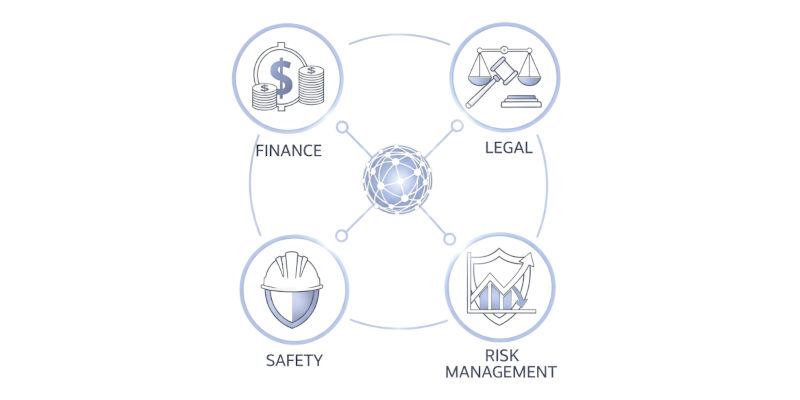
For decades, organizations have operated in departmental silos.
Finance manages budgets and forecasting. Legal oversees compliance and litigation. Safety works to prevent injuries and accidents. Risk Management typically manages insurance programs, claims, and loss control.
Each department operates independently with distinct priorities and metrics.
What if these departments shared a common mission?
In reality, they often do.
Every one of these departments ultimately exists to minimize financial loss and protect the organization’s long-term stability.
What would result if Finance, Legal, and Safety were aligned under a unified risk management strategy?
Integrating these departments could enable a more effective enterprise risk management approach.
Risk Management Is More Than Insurance and Claims
Many organizations still view risk management primarily as an insurance function, relevant only after an accident, lawsuit, cyber event, or workplace injury.
Modern risk management is much broader.
Effective risk management identifies, measures, controls, and finances risk before losses occur.
Whether the issue involves:
- Workers’ compensation claims
- Workplace safety incidents
- Liability claims
- Vehicle accidents
- Property damage
- Cybersecurity breaches
- Regulatory violations
- Operational disruptions
The outcome is often the same:
These events lead to higher costs, reduced productivity, operational disruption, and increased financial uncertainty.
Eventually, every major risk event appears in one place:
The financial statements.
This is why enterprise risk management is becoming a strategic leadership function rather than simply an administrative responsibility.
The Hidden Cost of Organizational Silos
One of the biggest challenges organizations face today is fragmented information.
Departments often collect valuable data, but that information rarely connects in a meaningful way.
Consider a common scenario:
- The Safety Department identifies a recurring workplace hazard.
- Legal is defending multiple claims related to that same issue.
- Finance notices increasing claim costs and reserve development.
- Risk Management sees a rise in incident frequency.
Each department sees part of the story.
No one sees the full picture.
As a result, organizations often respond to problems only after costs have begun to escalate.
This reactive approach can significantly increase the Total Cost of Risk (TCOR) and make it harder to identify opportunities for improvement.
Shifting from challenges to opportunity, what changes when risk management becomes the connecting hub?
Consider an alternative model.
Instead of operating independently, Safety, Legal, Finance, and Risk Management share data, insights, and objectives through a coordinated enterprise risk management strategy.
Safety: From Compliance Function to Risk Reduction Strategy
Safety programs become more than inspections, audits, and compliance requirements.
They become a proactive tool for reducing:
- Workers’ compensation claims
- General liability exposures
- Vehicle accidents
- Property losses
- Operational interruptions
When safety data is connected to claims and financial outcomes, organizations gain a clearer understanding of which initiatives are producing measurable results.
Legal: Identifying Exposure Before It Becomes Expensive
Legal teams possess valuable insight into:
- Litigation trends
- Emerging liabilities
- Contractual risks
- Regulatory concerns
- Compliance vulnerabilities
When legal information is integrated into the broader risk management strategy, organizations can identify patterns earlier and take corrective action before issues become costly claims or lawsuits.
Finance: Understanding the True Cost of Risk
Finance professionals are responsible for forecasting and controlling costs.
A unified risk management approach provides greater visibility into:
- Claim costs
- Reserve development
- Self-insured losses
- Litigation expenses
- Insurance program performance
- Operational disruptions
This visibility supports more accurate budgeting, forecasting, and strategic planning.
Risk Management: Connecting the Dots
Risk Management is uniquely positioned to serve as the central hub that connects operational, financial, legal, and safety information.
Rather than focusing solely on claims administration or insurance procurement, risk management can provide leadership with a comprehensive view of organizational risk.
In summary, centralized risk management leads to improved visibility, greater accountability, and better decisions.
Why Shared Data Leads to Better Decisions
Organizations today collect more data than ever before.
The challenge is no longer gathering information.
The challenge is connecting it.
Modern risk management software, claims management systems, safety reporting tools, and analytics dashboards make it possible to identify trends that would otherwise remain hidden.
When departments work together, organizations can:
- Identify emerging risks earlier
- Reduce claim frequency and severity
- Improve workplace safety outcomes
- Strengthen compliance efforts
- Control legal costs
- Improve operational efficiency
- Reduce the Total Cost of Risk
Instead of reacting to problems, leaders can make proactive, data-driven decisions.
Focusing on Total Cost of Risk (TCOR)
One of the most powerful metrics in risk management is Total Cost of Risk (TCOR).
Many organizations focus only on insurance premiums or claim payments.
TCOR provides a much broader view by incorporating:
- Insurance premiums
- Retained losses
- Deductibles and self-insured costs
- Legal expenses
- Administrative costs
- Safety program investments
- Lost productivity
- Reputational damage
- Operational disruption
When leadership evaluates decisions through the lens of TCOR, resources can be allocated more effectively to achieve the greatest financial impact.
The Future of Enterprise Risk Management
As organizations become increasingly data-driven, the role of risk management continues to evolve.
Today’s risk leaders are no longer simply insurance buyers or claims coordinators.
They are strategic advisors who connect information across departments to help protect the organization’s people, assets, finances, and mission.
In short, treating risk as an enterprise-wide strategy—rather than a series of separate functions—is essential for success.
The question arises: Should Finance, Legal, and Safety report to Risk Management?
An alternative consideration is: what opportunities might be missed if they do not?
Ultimately, every workplace injury, lawsuit, compliance issue, safety concern, and operational disruption affects a common factor: the organization’s financial health.
And that’s a responsibility every department shares.
What are your thoughts?
Should Risk Management play a larger role in connecting Finance, Legal, Safety, and Claims data? Or are organizations better served by keeping these functions separate?

Paul Kofman, President of Recordables, has been providing software solutions in Risk Management, Claims Management, Disability Management, Safety, and Occupational for more than 30 years.