
Artificial intelligence is rapidly reshaping the conversation around risk management, claims administration, workplace safety, and compliance.
Organizations across sectors are increasingly exploring how AI can improve efficiency, streamline workflows, and enhance visibility into operational risks.
The technology is also advancing rapidly.
AI-assisted tools now summarize claims activity, automate workflows, support predictive analytics, improve reporting consistency, and accelerate information access. These capabilities are especially valuable for organizations with increasing workloads and limited resources.
However, significant risks arise when organizations rely too heavily on automation without proper oversight.
At Recordables, we believe technology should enhance professional decision-making, not replace it.
This distinction is important.
AI Is Changing the Future of Risk Management
There is no question that AI has the potential to improve many areas of risk and claims management.
Organizations are increasingly using AI-assisted technologies to help:
- Identify claim trends and recurring loss patterns
- Improve incident reporting consistency
- Streamline document management and OCR data extraction
- Automate portions of administrative workflows
- Support predictive analytics and operational dashboards
- Accelerate reporting and information retrieval
For many organizations, especially public-sector entities and those with limited resources, these efficiencies provide meaningful operational advantages.
When implemented responsibly, AI can reduce administrative burdens and improve visibility into claims activity, safety issues, reporting delays, and operational bottlenecks.
This move toward proactive risk management is among the most significant changes in the industry today.
Predictive Analytics Can Improve Visibility — But Data Quality Still Matters
One of the most promising applications of AI in risk management is predictive analytics.
Organizations are increasingly evaluating how analytics and operational dashboards can help identify trends earlier, enabling teams to intervene before issues escalate into larger claims or compliance problems.
Predictive analytics may help organizations:
- Monitor claim frequency and severity trends
- Identify delayed incident reporting
- Recognize recurring workplace hazards
- Improve operational accountability
- Support earlier intervention efforts
- Strengthen overall claims visibility
- Recommend proactive intervention strategies and corrective actions
Predictive tools are only as effective as the quality of the data they use.
Incomplete documentation, delayed reporting, or inconsistent workflows can make AI-driven recommendations unreliable. Inaccurate inputs may lead to misleading outputs and increase operational risk.
Strong reporting practices, consistent documentation, and human review remain essential.
The Risk of Over-Automation
As AI adoption accelerates, many organizations find that automation without governance introduces new challenges.
Accuracy and accountability are critical in risk management, claims administration, and workplace safety. Poorly implemented AI systems may cause:
- Inconsistent claim summaries
- Incomplete documentation
- Privacy and cybersecurity concerns
- Records retention issues
- Limited transparency into automated decisions
- Overreliance on system-generated recommendations
This is especially important for public entities and organizations handling sensitive employee or medical information, where documentation standards, compliance, and operational transparency are essential.
Technology can support the process, but it cannot replace experienced professional judgment.
Why Human Oversight Still Matters
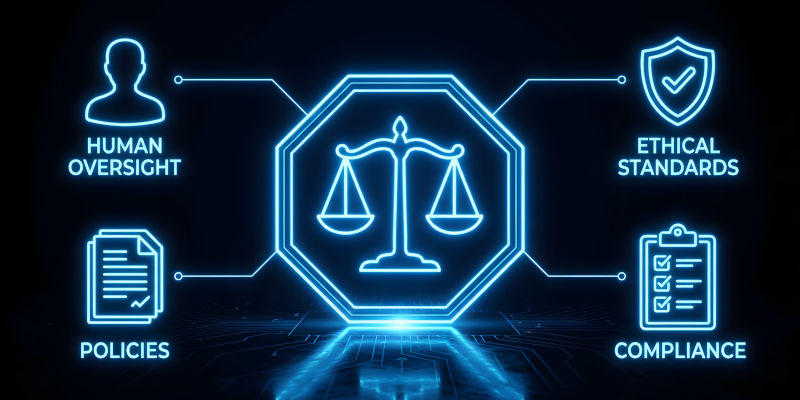
At Recordables, we believe effective risk management combines technology with experienced human oversight.
AI should support risk managers, claims professionals, safety teams, and administrators, not operate independently without review or accountability.
Successful organizations are implementing AI-assisted technologies alongside:
- Strong approval workflows
- Audit trails and reporting controls
- Role-based security access
- Escalation procedures
- Clear operational standards
- Ongoing human review and validation
This balanced approach improves efficiency while maintaining documentation integrity, compliance oversight, and accountability required for risk management programs.
The goal is not simply automation.
The goal is better decision-making.
Cybersecurity and Data Governance Cannot Be Ignored
As organizations adopt AI-driven tools, cybersecurity and data governance are becoming increasingly important considerations.
Risk management platforms often contain sensitive information, including claims, incidents, medical documentation, and employee records. Organizations must carefully evaluate how AI tools interact with:
- Claims and incident data
- Operational workflows
- Compliance requirements
- Privacy obligations
- Vendor security practices
- Internal cybersecurity policies
Best practices increasingly include:
- Encryption at rest and in transit
- Role-based user permissions
- Audit trails and activity tracking
- Secure approval workflows
- Vendor transparency
- Employee training and oversight
For organizations handling workers’ compensation, liability, or health-related information, strong security controls and operational accountability remain essential as AI adoption increases.
Responsible AI Starts with Responsible Processes
Organizations realizing the greatest long-term value from AI are implementing it thoughtfully, not just adopting technology quickly.
That means establishing clear policies around:
- Acceptable AI usage
- Documentation review procedures
- Data governance standards
- Records retention requirements
- Approval workflows
- Security and compliance expectations
AI can absolutely improve operational efficiency and visibility.
However, responsible implementation requires more than software alone.
It requires structure, oversight, accountability, and guidance from experienced professionals.
The Future of Risk Management Will Be Both Intelligent and Accountable
Artificial intelligence will continue to transform claims management, workplace safety, compliance, and operational workflows in both public and private-sector organizations.
Organizations that benefit most will likely be those that balance innovation with practical operational controls, cybersecurity, transparency, and human expertise.
At Recordables, we continue to evaluate emerging technologies, including AI, predictive analytics, operational dashboards, and reporting tools, based on real-world risk management needs.
Technology should do more than automate processes.
It should help organizations make smarter, safer, and more informed decisions.
Since 1992, Recordables has provided software solutions for workers’ compensation, claims management, safety, liability administration, and case management for organizations across the country. Through platforms like TrackComp®, TrackAbility®, TrackAlytics®, and TrackVerify®, we remain committed to helping organizations improve visibility, strengthen accountability, and proactively manage risk in an evolving operational environment.

Paul Kofman, President of Recordables, has been providing software solutions in Risk Management, Claims Management, Disability Management, Safety, and Occupational for more than 30 years.